
DocentLens

Audio guide for museums and galleries abroad

Snap the label.Hear the story.

Standing before a label in a language you can't read? Take one photo, put in your earphones, and listen. DocentLens adds context, unpacks difficult terms, and tells you why the work in front of you matters.

Download on the App Store Get it on Google Play

3 free a day · No account needed

DocentLens player playing commentary on The Milkmaid

What you hear

TranslationCommentary

A translation only repeats the label in your language. A docent tells you where to look — the era, the technique, the story behind the work. That is what plays in your ears.

How it works

Snap. Listen. Ask.

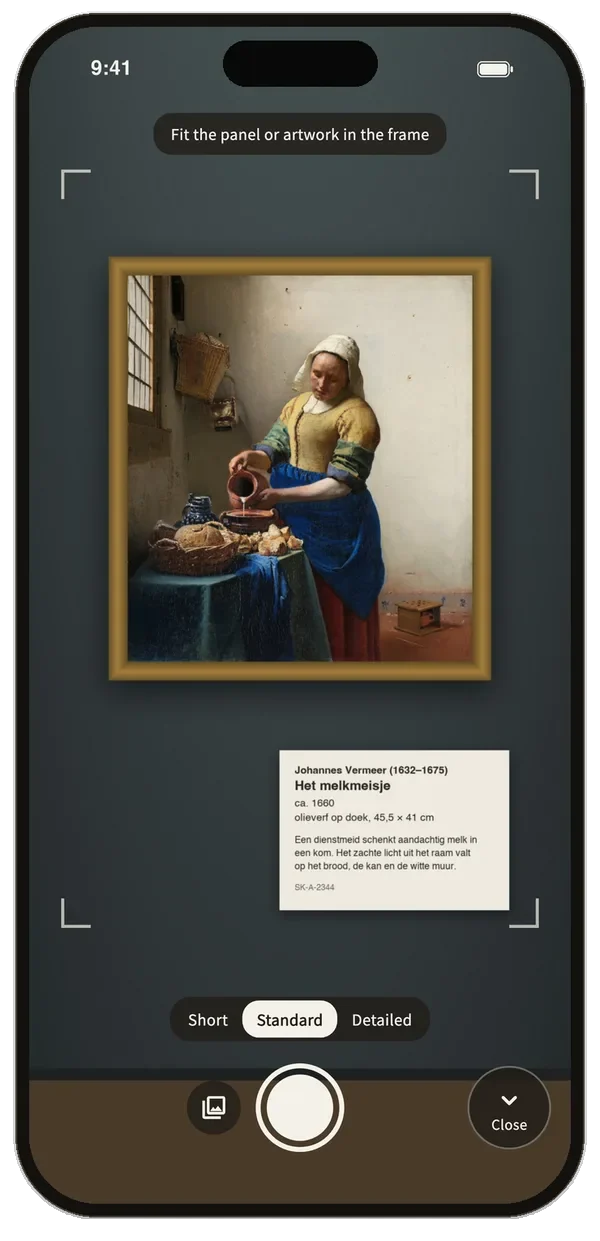
  1. Can't read the label? Just snap it.

    An exhibit panel or an artwork label — one photo is enough. Commentary starts within seconds.

    Capturing an artwork label
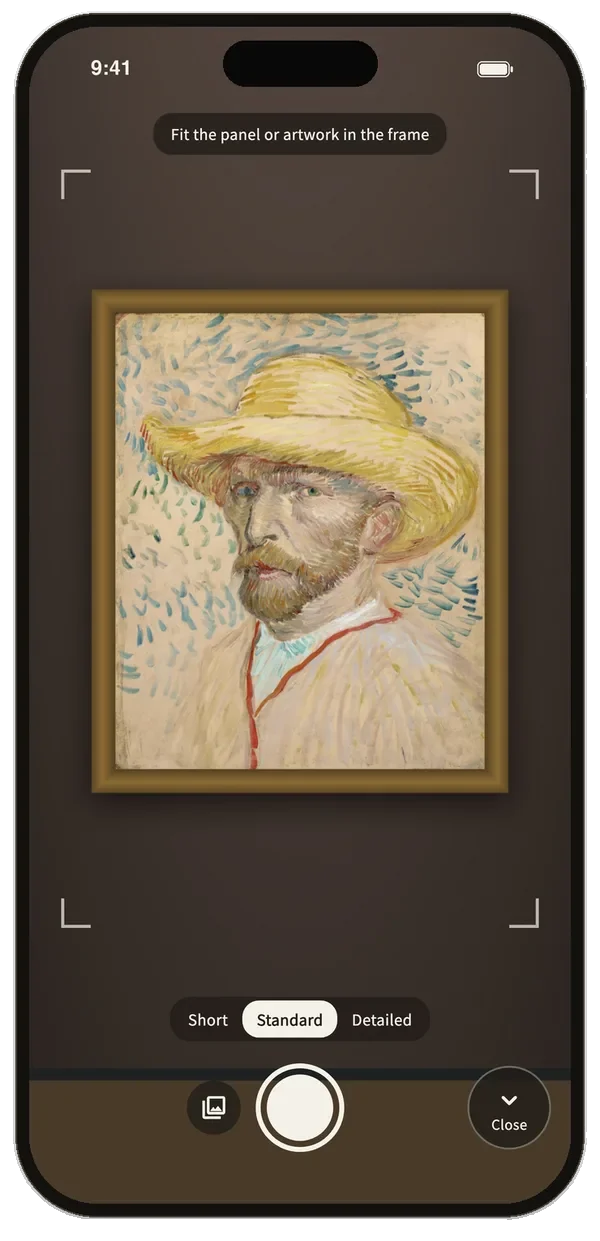
  2. No label? Snap the artwork.

    When the label is far away or missing, shoot the artwork itself and hear what DocentLens sees in it. Get the label in the same frame for the full story.

    Capturing an artwork without a label
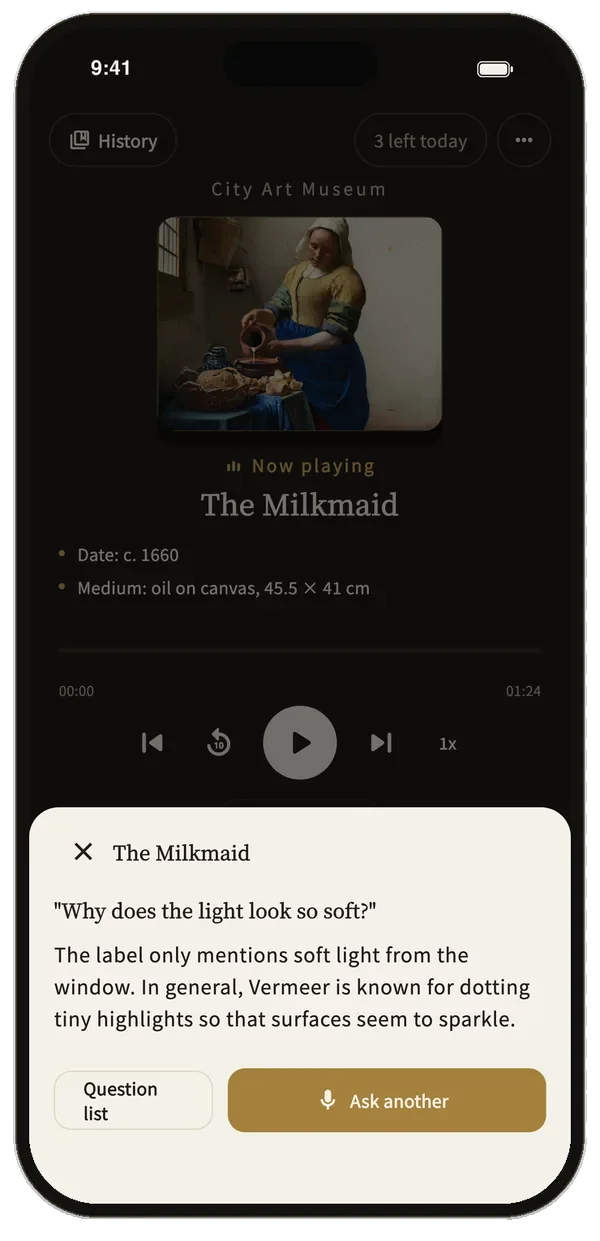
  3. Curious? Ask out loud.

    Hold the button and ask mid-listen — the answer comes back as audio, and your visit never loses its rhythm.

    Asking a question by voice while listening

Listen

One label, turned into a docent talk

We sent photos of an artwork and its label exactly the way the app does. The scripts and audio below are the AI commentary as it came out, unedited. Compare them with what the label actually says.

Van Gogh's Wheat Field with Cypresses on a gallery wall next to a French labelFrench label

Wheatfield with Cypresses

Read the script · 0:42

Take a look at the swirling motion in the sky and the golden field swaying below. This vibrant landscape was painted by Vincent van Gogh in 1889. According to the wall text, he created this piece in Saint-Remy-de-Provence during his stay at the Saint-Paul-de-Mausole asylum. Notice the tall, dark green cypress tree standing prominently on the right side of the canvas. In a letter to his brother Theo, Van Gogh mentioned that he compared cypresses to Egyptian obelisks because of the beautiful harmony of their lines. Looking at the thick, rhythmic brushstrokes across the surface, you can really feel the intense energy and emotion he poured into capturing the sun-drenched countryside of southern France.
Download this photo
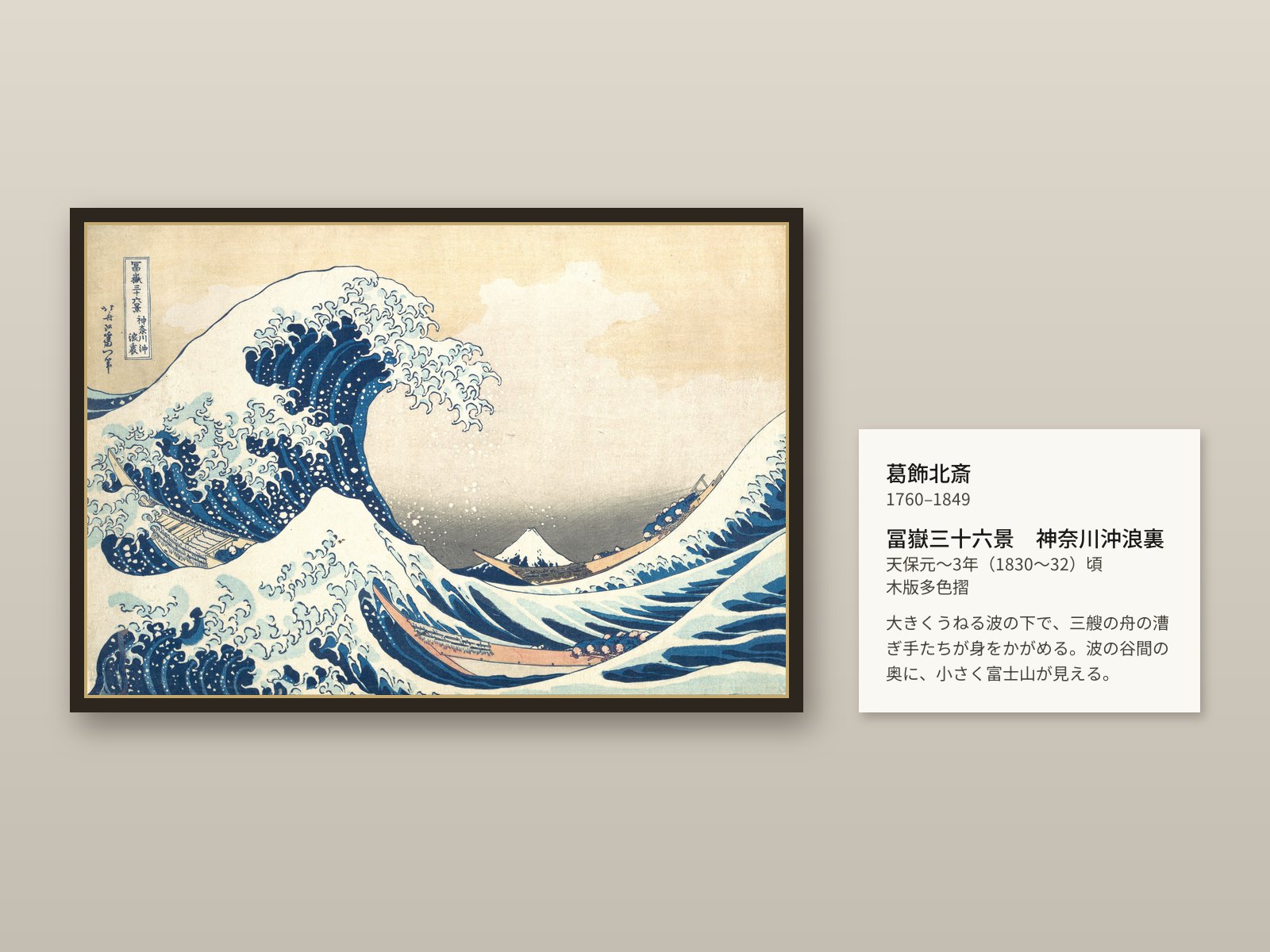
Hokusai's Under the Wave off Kanagawa on a gallery wall next to a Japanese labelJapanese label

Under the Wave off Kanagawa, from Thirty-Six Views of Mount Fuji

Read the script · 0:46

Notice the overwhelming power of the towering blue crest curling over the scene. As your eyes move across the print, you can see rowers in three slender boats crouching low against the sheer force of the water. Tucked quietly in the trough between the churning waves, Mount Fuji stands small and serene in the background. According to the label, this famous woodblock print was created around 1830 to 1832 by the Edo period master Katsushika Hokusai. It is widely known as one of the most iconic masterpieces of Japanese art, celebrated for its dynamic composition and vivid use of imported Prussian blue ink. Hokusai cleverly uses linear perspective to contrast the fleeting drama of the ocean with the eternal stability of Mount Fuji.

Download this photo
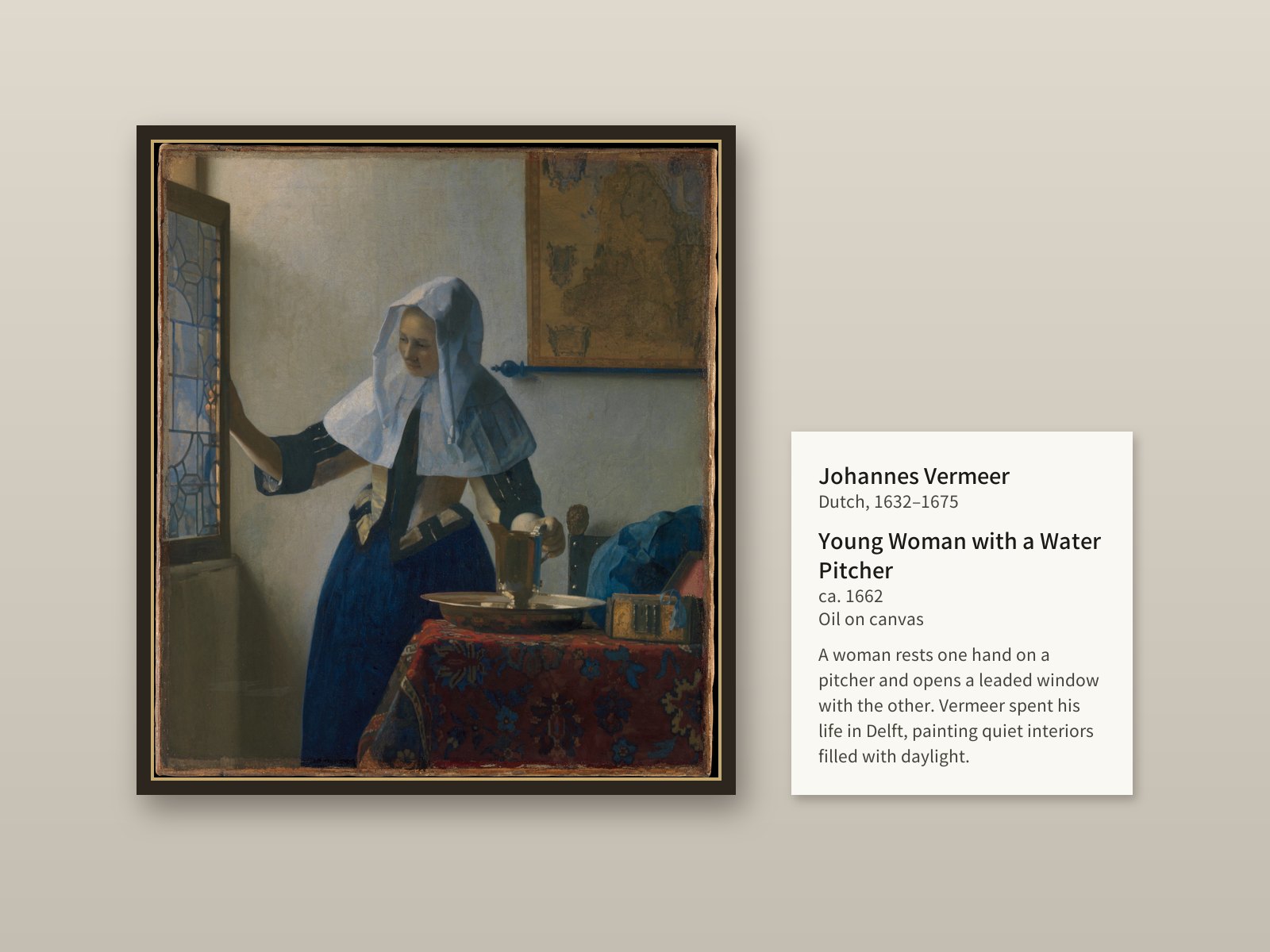
Vermeer's Young Woman with a Water Pitcher on a gallery wall next to an English labelEnglish label

Young Woman with a Water Pitcher

Read the script · 0:45

Take a moment to look at the gentle morning light streaming in from the left window. Notice how soft cool reflections brush across the woman's white head covering and spill over the shiny metal pitcher on the table. Johannes Vermeer created this oil painting around 1662. According to the label next to the canvas, a woman rests one hand on a pitcher while opening a leaded window with her other hand. It also notes that Vermeer spent his life in Delft, capturing quiet interior scenes bathed in natural daylight. Widely known as a master of light, Vermeer painted calm domestic moments that feel still and timeless. Notice how the rich blue skirt and the patterned tablecloth bring warmth and balance to this peaceful room.

Download this photo

Download a photo and import it from your gallery in the app to try it yourself. You can hear the audio here, so one photo is enough in the app. The free plan gives you 3 a day.

Artwork images: The Metropolitan Museum of Art, Open Access (CC0). The labels were made for this page and are not from a real museum.

On the gallery floor

Small things that fit a museum day

Shoot several, hear them in order

Capture exhibits back to back and they play in the order you took them.

Phone in your pocket

Lock screen and background playback — keep your eyes on the art.

Replay your visit

Listen again to today's commentary anytime, at no extra cost. Stored only on your device.

The original text, too

See the label's original text alongside, with anything the label doesn't confirm flagged separately.

Photos you already took

Import label photos from your gallery and listen to those too.

Four languages

English · 한국어 · 日本語 · 繁體中文 — commentary and questions in the same language.

Price

Pay only on the days you need it

3/ day

Free every day

Up to 3 descriptions a day with no sign-up. The count refills daily.

24hours

24-hour pass

Spending the whole day at a museum? Unlimited descriptions for 24 hours. Not a subscription — no auto-renewal.

Your photos aren't stored on our servers

Photos are used only to create the commentary and are not stored on DocentLens servers. Your visit history stays on your device.

Next gallery

Try it in the next gallery

Available on iPhone and Android.

Download on the App Store Get it on Google Play